

How rural startups can win earned media
A guide to leveraging media relations as a rural founder

Welcome back to The Rural Startup, a bi-weekly newsletter for founders building outside city limits. Each issue delivers expert advice tailored to the realities of rural entrepreneurship.
Today, we’re diving into one of the most powerful tools you can use to raise brand awareness and credibility: earned media.
At some point—whether you’re pursuing funding, driving sales, or positioning for strategic growth—you need more people to know who you are and why your business matters. Earned media (such as articles, TV spots, podcast features, or organic influencer recommendations) can be one of the smartest ways to make that happen.
Third-party validation carries weight. When a credible outlet tells your story or features your product, it enhances trust, visibility, and momentum in ways paid ads or even your original content cannot. On top of that, you’re tapping into an established audience by leveraging a media outlet’s reach to grow your own.
For rural founders, earned media in statewide or national outlets can expand brand awareness far beyond your immediate customer base. At the same time, a feature in your local newspaper can deepen trust and strengthen loyalty within your own community. When approached strategically, earned media—both big and small—can meaningfully accelerate your business growth.
Helping us today is Anna Rice, founder of Alpine Marketing & Communication, based in Dillon, Colo. With more than 15 years of experience securing media coverage for global companies—including roles in-house, at boutique firms, and at Edelman—she shares how rural founders can approach media relations strategically and effectively.

The Right Time to Start Media Relations
Unlike social media, paid ads, or even your own content, earned media doesn’t require constant posting or visibility. Anna says it’s about building the right relationships and reaching out at the moments that matter—both for your business and for the media. If you reach out too early or too often without a truly newsworthy angle, you risk spending time and money on a story that isn’t strong enough to earn coverage.
So what actually counts as newsworthy? Reporters and content creators are looking for developments that matter beyond your internal wins. A new logo or a website refresh isn’t a story (unless you’re Apple and you decide to rebrand as Peach).
A newsworthy story is measurable progress, meaningful change, or impact that affects customers, your community, or your industry.
For rural founders, that might look like:
Product launches that materially change what’s available in the market
Money changing hands (funding, acquisitions, investment)
New events or opportunities for in-person, local audiences such as your opening day party
Significant hires, business expansion, or job creation metrics
Major customer adoption, especially recognizable names
Here’s a real life example of a newsworthy moment: a fine art gallery wanted to participate in a monthly art walk. Each month, they featured a new artist and sent a press release to the local paper. The editor covered it once or twice, but eventually, he stopped. Why? Because a recurring monthly exhibition isn’t inherently newsworthy.
So the gallery changed their angle. They partnered with several artists to design custom wine labels, placing them on white-label bottles. Then, they hosted a wine tasting with a local sommelier and invited guests to explore how the art influenced their perception of the wine. That fresh, creative hook earned a full-page feature in the local A&E section and drove a packed event.
Pulse Check: Is Your Business Ready for Earned Media?
Media coverage only matters if you can capitalize on it. Anna once secured a Today Show feature for a client. It was a huge PR win that quickly became a problem because the business wasn’t ready. Orders surged, inventory ran out, and the company’s website crashed.
Before pursuing coverage, pressure-test your readiness:
Identify a clear goal for the coverage.
Know how you’ll manage inbound interest.
Make sure you have the time and internal resources to support it.
Sometimes you only have one shot with a specific outlet, so don’t use it before you’re ready.
Get Started: Media Relations Framework
Media relations works best with a repeatable structure, customized for each pitch. Here’s a simple framework Anna uses to guide outreach at any stage.
1. Define the audience you want to reach.
Go beyond geography. Are you trying to reach a specific industry? Parents? Outdoor enthusiasts? Healthcare administrators? Investors? Be precise. “Everyone” is not a strategy.
2. Identify where that audience gets information.
A newspaper may be powerful—or completely irrelevant—depending on who you’re targeting. If your ideal customer is Gen Alpha, traditional print won’t move the needle.
3. Develop a clear, compelling story.
What’s the hook? Why does it matter now? Who does it impact? Strong pitches focus on relevance and timing. Read more about telling your brand story.
4. Get it to the right person.
Generic inboxes rarely work. Find the reporter or creator who covers your topic. Yes, this takes research. If budget is tight, consider hiring an intern or virtual assistant to build a targeted media list so you’re not pitching blindly.
5. Pitch with simplicity and directness.
Don’t overcomplicate it. State the hook clearly, explain why it matters, and make it easy to understand in 30 seconds or less.
6. Back it up with proof.
Traction, numbers, partners, customer results, visuals, other earned media—evidence builds credibility. Without proof, it’s just a claim.
7. Follow up. But don’t be a nag.
Reporters’ inboxes are crowded. A missed email is common, not personal. It’s absolutely appropriate to send a brief, polite follow-up that restates the core hook and why it matters now. Keep it short and respectful. If there’s still no response, move on.
Local Media: Your First and Strongest Advantage
Most companies don’t jump from obscurity to the Today Show. Media relationships are built in steps. Local stories or features in smaller publications today can set the stage for broader and bigger wins in the future. Media attention often snowballs. When editors see a story gaining traction elsewhere—especially in credible industry outlets—it signals relevance.
For example, one outdoor recreation brand in Durango spent years pitching major publications like Outside and Backpacker without success. Then, after earning coverage in local press, followed by smaller online outlets such as GearJunkie, the larger publications took notice. That exposure eventually led to top awards from Outside and Backpacker, and later a feature in New York Magazine.
Engaging local media is a strategic entry point that builds credibility within your community and lays the groundwork for broader coverage.
Your local impact is inherently newsworthy. Hiring, economic contribution, community involvement, and local pride are exactly what regional reporters care about. Study what they cover, and pitch your story through that lens.
Local coverage fuels larger opportunities. “National media look to local outlets for story ideas all the time,” says Anna. “It’s social proof that a story resonates somewhere already.”
It may be more accessible than many founders realize. Reporters often respond positively to hearing directly from a founder. A strong pitch may require nothing more than a short follow-up conversation.
When (and How) to Go Bigger: Pitching National Media Markets
Scale your media reach when your story scales.
“To earn national coverage, it needs to influence people who have never heard of you before,” Anna says.
The hook might be a sizable investment, a unique solution to a localized yet common challenge, or a product launch with national relevance. At this stage, a compelling founder’s story can open doors, too, especially if it shows real stakes.
“Founders often focus only on successes,” Anna notes. “But it’s the tension, challenges, and pivots that make a story interesting.”
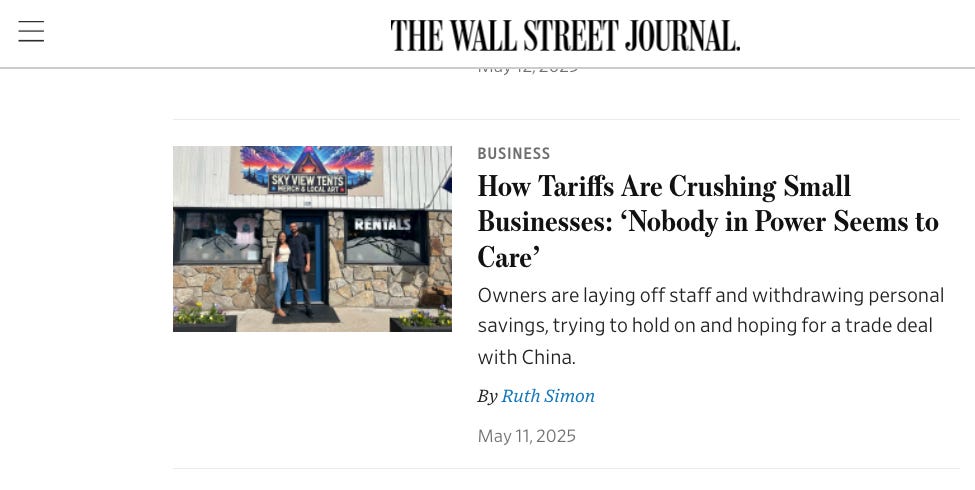
Last year, the CMO of Sky View Tents in Buena Vista, pitched a story to The Wall Street Journal about how tariffs were affecting small businesses. Rather than centering the pitch on their company alone, he outlined a broader trend and referenced several other impacted businesses—knowing it was unlikely the paper would run a story focused on a single brand.
“The WSJ article boosted our typical traffic by 20x for two days straight, it also led to record sales those days,” Joseph Bissonnette, the founder of Sky View Tents said.
Sharing the twists and turns behind your progress helps journalists—and readers—understand why your mission matters. If you’re comfortable telling your story as it unfolds, consider starting a newsletter, blog, or podcast. Consistent original content can attract earned media attention, especially from business reporters looking for credible founder journeys.
Highlighting rural headquarters can also add intrigue through novelty, but only when it supports the story. However you approach the narrative, honesty, specificity, and clear proof points often outperform hype. Read more about building “rural” into your brand identity.
Bonus Tip: Don’t overlook national trade media. For B2B companies, trade outlets reach your customers directly. For consumer brands, they influence distribution, product launches, and investors. Major business media monitor the trades closely for emerging trends.
Standing Out as a Rural Founder in a Crowded Media Landscape
“It’s kind of a myth that startups in big cities have a better chance of landing media coverage,” says Anna. In lower population areas, there’s simply less competition for attention. A Massachusetts native, she puts it plainly: “It’s much harder to get into the Boston Business Journal than the Worcester Telegram.”
The moral of the story? Don’t underestimate your position. In many cases, you’re competing in a smaller pond, with fewer pitches and more room to be noticed. Focus on strong stories, real proof, and consistent relationship-building, and media coverage is within your reach.
—
This newsletter is powered by Startup Colorado. We believe that anyone should have the ability to start and scale a business in the place they call home. And in Rural Colorado, we’re seeing the power of entrepreneurship transform communities and lives, proving that the spark of innovation can—and should—be kindled outside urban hubs.
Produced by Margaret Hedderman, Director of Communications at Startup Colorado. Written by Brook Sutton with support from Anna Rice.